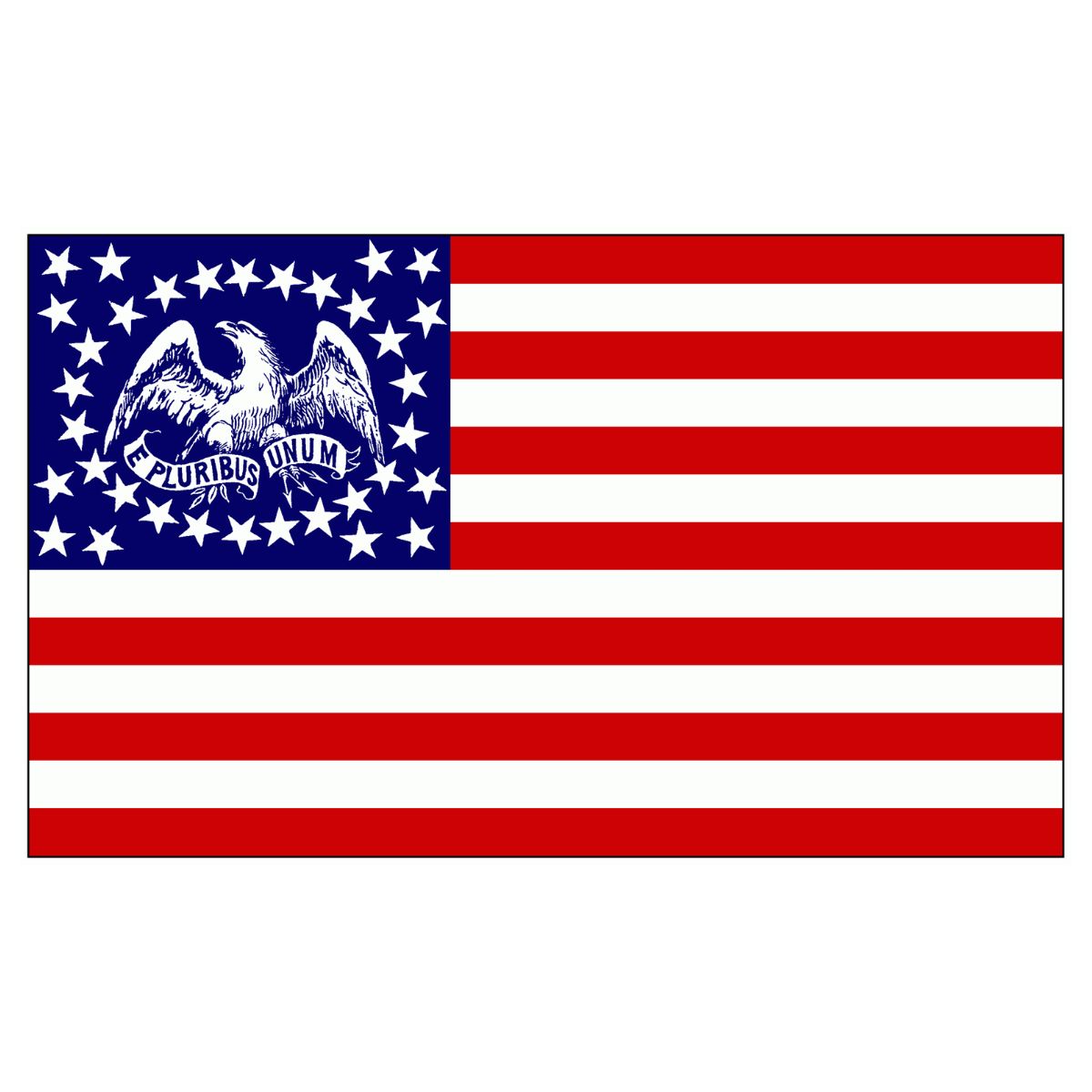
This is another addition of a cool flag that comes from your suggestions. This time it is again from Dave Martucci who provided the historical information published below.
Dave writes:
When the Civil War began in 1861, Northern suppliers were suddenly faced with an unexpected demand for the Stars and Stripes. People all over the North wanted to display the flag on their buildings and wave them at parades. Military units created another demand that was difficult to meet. The existing flag makers were not able to supply everything that was needed so many new manufacturers sprang up overnight. Most made flags by sewing the whole flag or by sewing the main body and then having the details painted on. A few, however, experimented with new technologies to meet the demand for a plentiful supply of inexpensive flags for the less affluent part of Northern society. Thus was born a subset of the flag making industry still going strong, printed flags.
At the time, the cutting-edge technology for printing flags was “clamp dying.” This process had been patented in the early 1850s but had not been widely used until there was a demand for vast quantities of cheap flags. The process involved two metal plates cut out with a matching design on them which would be clamped together with a sheet of cotton cloth between them and then immersed into a vat of appropriate color dye. Once dried, the clamp was removed and where the metal plates had been gripped together, the fabric remained the original color while the rest had been dyed. Dozens of small flags could be made at one time using this method and larger flags were made in sections and stitched together.
For example, some copies of this design were made in three sections, the canton (blue dye on white fabric), the top seven stripes, and the bottom six stripes (both red dye on white fabric) and then the three sections would be sewn together. Smaller flags, such as the 12 x 18 inch hand-wavers we are still familiar with today were dyed with the red stripes and then with the blue canton in two separate clamp dye jobs on single or multiple one-piece flags. Since the printing allowed a design of much complexity, some clamp dyed flags made in 1861 bore the American Eagle as well as the 34 stars, a design motif that was very popular at that time.
Features:
-
Size: 3′ x 5′
-
Material: Durable, lightweight nylon
-
Design: Digitally dyed for bright, long-lasting color
-
Heading: Reinforced polyester canvas
-
Attachment: Brass grommets for secure hanging
Proudly made in the United States. This flag is made to order—please allow 7–14 days for delivery.