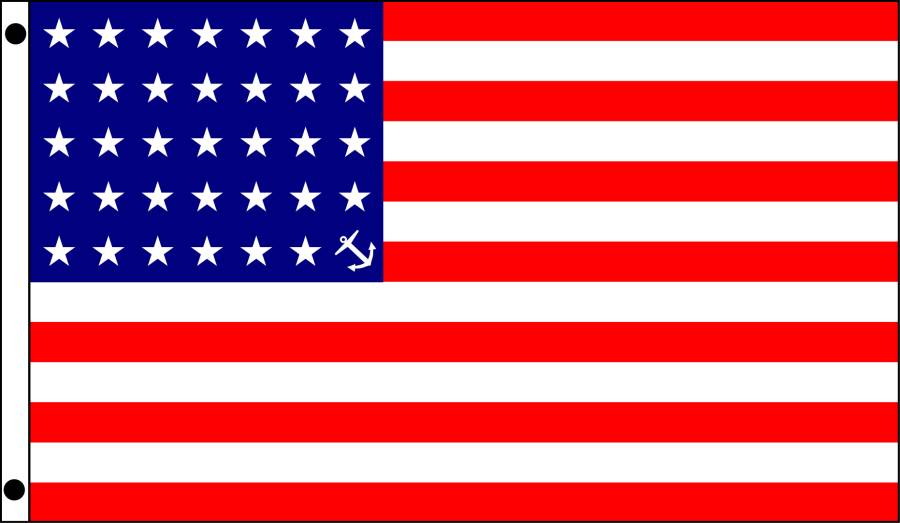
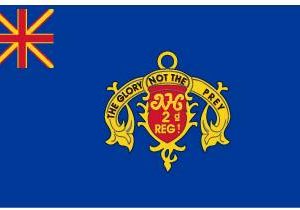
Largely based on customer requests, we continue to introduce historic flags you don’t see every day. As a wise man once said, “Flags are the shorthand of history.” Two such flags were discovered at the NAVA 39 Conference in Nashville (October 2005) and are a direct result of what was learned there.
The story behind these two flags is a story of country and family, and of the painful divisions faced by Americans during the War Between the States—a time when fathers fought sons and brothers fought brothers. These flags also tell the story of how the beloved term “Old Glory” came into use.
William Driver and “Old Glory”
William Driver (1803–1886) was a Massachusetts sea captain who sailed around the world twice and circumnavigated Australia once. In 1831, he rescued the descendants of the HMS Bounty mutineers from Tahiti. Driver named his personal American flag “Old Glory.”
The version shown here reflects how the flag appeared around 1861, after his daughters updated his original 24-star flag. Notably, it includes an anchor in the lower right corner of the canton, a detail reflecting Driver’s life at sea.
Retired in Nashville, Driver remained a staunch Unionist during the Civil War. His loyalty made it necessary to hide Old Glory—some accounts say from Confederate sympathizers in the city, others even from members of his own secessionist family. When Union forces occupied Nashville in 1862, Driver asked that his flag be raised over the Tennessee State Capitol. It was. The image of Old Glory flying over the first major Southern city captured by Union troops was widely reported in Northern newspapers and helped popularize the enduring nickname for the American flag.
Driver’s original flag, measuring approximately 9 × 15 feet, is preserved today at the Smithsonian Institution. He is buried in Nashville City Cemetery, alongside members of his family.
A House Divided: George Driver
At the same time, George Driver, William’s son, was serving as a Confederate private in the Rock City Guards, a Nashville militia unit that later became part of the 1st Regiment of Tennessee Volunteers. Their flag—shown alongside Old Glory—was made in April 1861, after Virginia joined the Confederacy but before Tennessee formally seceded.
According to research cited in a November 26, 2005 historical posting, the flag’s nine stars reflect this uncertainty: eight stars within the circle represent the Confederate states at the time, while the ninth star outside the circle symbolizes Tennessee—not yet fully “in the fold,” but on the way. The original flag measures approximately 3 feet wide by nearly 7 feet long and is housed in the Tennessee State Museum.
George Driver later died of wounds sustained at the Battle of Perryville, a tragic reminder of the war’s cost—not only to the nation, but to individual families.
Features:
-
Size: 3′ x 5′
-
Material: Durable, lightweight nylon
-
Design: Digitally dyed for bright, long-lasting color
-
Heading: Reinforced polyester canvas
-
Attachment: Brass grommets for secure hanging
Proudly made in the United States. This flag is made to order—please allow 7–14 days for delivery.
Larger sizes are available—please inquire for details.